

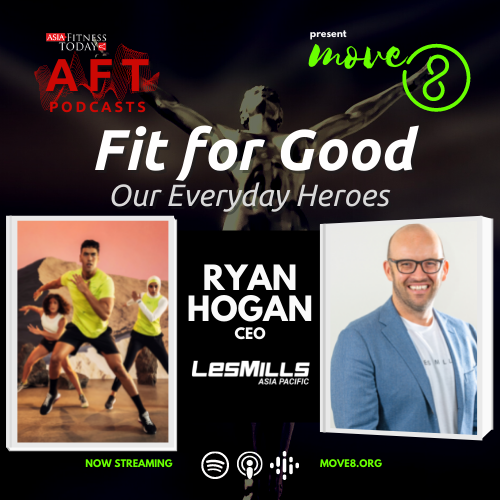
AFT Interviews: Ryan Hogan, CEO of Les Mills Asia Pacific is on a mission to make the planet fitter and healthier
BAHASA MALAYSIA

AFT Podcasts presents The Move 8, Move It, Move AID Podcast, giving insight into the hearts and minds of everyday people who use rhythm and movement as therapy to live well and be happy. Co-hosts Jasmine Low & Nikki Yeo created the Move8 Fitness Movement in 2018, and have been perfecting the eight pillar method towards living well.

Turn on captions on this podcast video to read the transcript: https://youtu.be/EGTMPNERjwE

Also streaming across all podcast platforms.

Podcast Transcript

Introduction

In this episode, we meet Ryan Hogan, CEO of Les Mills Asia Pacific who is pursuing a mission for a fitter, healthier planet! Originally from Canada, Ryan has been spearheading the fitness industry for the last two decades and one of his best known work is at FILEX – THE largest leading Fitness Education Event. He oversees Les Mills in over 14 countries from Canberra, Australia to Malaysia, Philippines, Indonesia, Singapore, Brunei, Vietnam, Thailand, Myanmar, Cambodia, Laos, Maldives, Guam and Papua New Guinea.

An Olympian and Commonwealth Games athlete by the name of Les Mills set up a gym in Auckland, New Zealand 50 years ago in 1968. It took 30 years of gym building, an innovative pre-choreographed barbell workout known as BODYPUMP® and the vision of an entrepreneur named Bill Robertson from Canberra to revolutionise the fitness industry with BODYPUMP® making it the world’s most famous group exercise class. Then came Les Mills Asia Pacific and Les Mills International, and today, a business that licences 20 different programs to over 21,000 clubs in over 110 countries with over 140,000 accredited Instructors delivering group workouts to over 7 million people each week. 

1:40 (AFT-Jasmine): WOW! How did you guys get to 140,000 instructors?

(LMAP-Ryan): It’s been a long journey. It was a concept in the mid 1990s that exploded around the world that included a lot of hard work, a lot of people hitting the roads, waving the flag, doing a lot of hard yards.

Ryan Hogan, CEO Les Mills Asia Pacific (2)
Ryan Hogan – Photo credit Les Mills Asia Pacific

2:15 (AFT-Jasmine): You spent a substantial part of your career in the business of fitness. How did that happen and what drove your passion in fitness?

(LMAP-Ryan): My whole career has been in the fitness industry. I have been a gym member since I was very young. I fell into a gym where I grew up, I joined group fitness, at the time in the 80s and 90s, and called it Aerobic Dance. I come from a family where music was a part of our lives and there was something about the rhythmic nature of exercising to music and being in a large group, so it really gelled with me. So from there, from being a very annoying and challenging participant to becoming an instructor while I was in business school. I’m very fortunate and grateful for the journey that it’s been and I’ve always been in fitness.

I grew up in Mexico and gym membership was quite affordable yet it was something the middle and upper class did, not dissimilar to other countries. Mexicans are really into their sport – soccer or football. So fitness was a new thing in the mid 90s, but as the middle class grew, as disposable income grew, not dissimilar to Southeast Asia, so did activities like fitness at gyms.

Ryan Hogan, CEO Les Mills Asia Pacific
Ryan Hogan – Photo credit Les Mills Asia Pacific

4:57 (AFT-Jasmine) I understand your mum is an academic and you moved from the UK to Mexico. How did Mexico shape you?

Mum teaches English as a second language. She’s an English professor and that’s how we ended up in Mexico. Both of us were born and bred in Toronto, Canada and mum took a post in Mexico 30 years ago and she’s still there! It’s a wonderful place, full of wonderful people, great food and culture!

5:25 (AFT-Jasmine) There’s a city, Oaxaca where its Mayor came up with a law and banned kids under the age of 18 from buying sugary drinks.

(LMAP-Ryan) Mexicans, other than people from the United States, are some of the highest consumers of the soft drink in the world. They drink it by the gallon (litre), but that’s a great initiative because it’s a massive contributor to obesity and unhealthy habits.

6:00 (AFT-Jasmine) In those Spanish speaking countries like Mexico, music is such a core in their cultures. When designing the Move8 Fitness Movement, we were inspired by a video called FOLI, about the Malinke tribe in Africa. A gentleman in the video says, “there can be no movement without rhythm”. When you think of Les Mills programs, it’s all about dance, music, it’s fun and social.. it’s not even exercise. Tell us how you’ve grown this brand in this lateral way.

(LMAP-Ryan) I’ve been with Les Mills for three years but I’ve been involved as an instructor for a long time teaching body pump groups.

Philip Mills, who is very central in the creation of the Les Mills family will talk about music being really central in what we do. We’re pretty obsessed about music, and the equality of music. Our licensing team in New Zealand, we’ve moved towards creating our own music and employing recording artists. We’re now the largest employer of recording artists in New Zealand because of what we need to produce to be able to distribute around the world. Our obsession with quality and the refinement of every single piece is a big part of what’s driven our success.

It must stem down to the DNA of the Olympian, doesn’t it? We understand Mr. Les Mills holds the record for discus for 40 years?!

(LMAP-Ryan) You’d have to! If you’re performing at that level, you’ve got to be obsessed with quality.

8:20 (AFT-Nikki): You’ve been in the business of fitness, driving membership sales, engagement and upskilling of fitness coaches. Recently, Les Mills has taken Virtual Fitness even further with the new app Les Mills PLUS. What are your thoughts on group fitness in the Metaverse?

(LMAP-Ryan) A good question, so bear with me. I think digital fitness, we’re sitting here at the end of 2021 after two years of dealing with Covid and we know that in the pre-Covid-19 world, people were exercising at home, people’s patterns were changing. It was no longer that the gym was the be-all and end-all for where you would consume your exercise. As people were more time poor, especially in larger cities, digital democratises everything and becomes accessible to everyone for everyone who had access to the Internet and to digital devices and fitness was a part of that. In the last six to seven years, there has been a huge explosion of digital fitness. At-home-fitness is not a new phenomenon. Anyone who was around in the 80s, would remember your parents plugging in the VHS video in the lounge room and doing some step aerobics (Jack Lalaine or Jane Fonda). But of course digital brought it front and centre, and democratised fitness at home. As it relates to us at Les Mills, a few years ago we thought this was something we looked at, we’ve been in the business of distributing our product, our content through the health clubs for 20 odd years but we were looking at how we could grow, to help our club partners go beyond the four walls and go wider and in line with our global mission to get more people ‘For a Fitter Planet’, filling up the gyms and getting more people more active. So we started investing in the Les Mills On Demand, which is now called Les Mills PLUS which is a consumer-facing app and Covid-19 just exploded! Digital is here to stay.

LesMills Athletic (2_1577)
Les Mills Group Fitness – Photo credit Les Mills Asia Pacific

We ran a consumer behaviour survey in May 2021 and we surveyed over 12,000 fitness consumers around the world asked what are your habits going to be like post-pandemic. Majority said, I definitely miss being around my friends, being in the gym, I miss group workouts. But I’m used to, and enjoy the convenience of working out from home. They overwhelmingly said they’d spend 60% of their time working in the gym and 40% working on it on their own. So it’s here to stay and the technology will grow in leaps and bounds. At the moment we’re engaging through an app, or the TV, watching and engaging. The next step would be virtual reality, augmented reality between the third place between work and home. I think we’re only getting started.

If you look outside the Les Mills environment, Apple, Amazon, Google… Google bought Fitbit, Apple’s mission is around health and making the world healthier, so there’s lots of interesting times ahead. Very disruptive times for those of us in the traditional space, but lots of opportunities as well.

12:27 (AFT-Jasmine) With this huge meta universe coming ahead, what is Les Mills really all about?

(LMAP-Ryan) We’re for a Fitter Planet. How we contribute towards a fitter planet is by creating life changing group fitness experiences. We’re obsessed about the quality of our classes, we’re obsessed about the quality of our instructors that deliver at them and we really really believe in the power of exercising in groups.

LesMills Virtual Fitness
Les Mills Virtual Training – – Photo credit Les Mills Asia Pacific

Given my background even pre-Les Mills, exercising in groups is what changed my life. In the Les Mills world, we have this term we call groupness. I mean it’s not a real word, but the power of groupness is the stickiness of being in a group, it’s the accountability of being in a group, of turning up to a class with your friends, the connection you have with the instructor on stage who’s super prepared to deliver a rock star experience, it’s the lift of energy that you get from being around others.

Like all of us, I’ve been through quite a few lockdowns during these Covid times. I’ve got a pretty good home setup so I trained through it because exercise was a part of my life but lockdown wasn’t going to stop that. I do the same workout at home but I found that my heart rate monitor showed I worked 30% harder when working in a group with colleagues at the studio than when being at home. And that’s the power of a group! It’s the collective lift of being around people who are working out with you with an instructor. The power of rising tides.

Another analogy I can make is the difference between listening to music on Spotify and when listening to that same song performed live in a concert, performed in front of a live audience, it’s the power of rising tides, that’s the power of groupness.

15:00 (AFT-Jasmine): It’s like how we came up with Move8, the eight is an idea where you need eight people in your circle to encourage each other to move.

I come from a family where we have a history of Type 2 Diabetes. I was pre-diabetic but since starting these podcasts, I have managed to reverse my pre-diabetes. So this is what we wish to share with these podcasts.

What Les Mills is trying to do across Southeast Asia, including in Guam, Maldives.. It’s a really amazing thing. So if I’m a fitness instructor and I’m interested in joining Les Mills, how do I do that?

(LMAP-Ryan) We’ve trained over 140,000 active instructors over the world, and hundreds of thousands of instructors over 25 years, we’ve been pretty good at the system we’ve created. If you’re in Southeast Asia or Australia, it’s a three-day process broken up over a couple of months. Do some pre-work, you’ll get your programme materials whether it’s body pump or body combat or whatever you wish to so and learn them beforehand, then two-days of immersion where you get taught the basics of what’s required in delivering a world class experience. After those two-days, you go out and work with an instructor mentor at your local health club, and you start shadowing where you are on stage standing behind the instructor, mimicking the movements without teaching, then eventually you start team teaching, where you share the class, where your mentor will give you feedback. Eight weeks later, you turn up on day three, where you then present (teach) a couple of songs to your peers several times and after day three if you’ve met the criteria and passed the assessments, you start teaching. It’s not easy! We’re known for the training not being easy at all. It’s a physically demanding training, because you need to be a physical role model if you’re going to be an instructor with the brand. We have very strict criteria and it’s even possible to fail. But we pride ourselves in the criteria you’ll need to meet and beyond training, there’s constant upskilling. Our programmes get updated every quarter and our instructors will need to upskill every quarter by learning the new releases.

This is how we maintain our obsession with quality. We’ve done 120-130 releases every three months and we’ve not stopped even during Covid. We have to update every quarter and we have to make sure that we have the latest moves and the latest music, and we’ve not stopped even during Covid. We made sure we found a way to make it work even during strict lockdowns. Our content globally is produced in Auckland, New Zealand where our recording studio is located. This obsession with quality is really a part of who we are.

19:50 (AFT-Jasmine) How does a gym owner sign on to a Les Mills partnership?

When you partner with Les Mills, we’ll come in and licence the products and classes, and we add value by supporting you with managing your group fitness timetable. Often health clubs are small to medium sized businesses and have a number of different challenges and group fitness is one of them. We really partner with the clubs and bring value. The group fitness real estate and health club should be the most profitable piece of real estate within the health club because of the number of people you can turn around.

21:00 (AFT-Nikki): Do tell us even more about the Les Mills mission, “For a Fitter Planet”.

(LMAP-Ryan) There’s this book by Simon Sinek, “Start with Why”, great businesses start with why and what a more awesome why than For a Fitter Planet. It’s really about everything that we do. We believe in the power of fitness to really transform the planet, to transform the way we live and our health. Fitness is one element of health, it’s what you eat, your sleep, it’s about creating a Fitter Planet. We believe through the quality of our group fitness classes, whether it’s in-club or it’s at-home through the Les Mills PLUS app, we can really contribute to a healthier and fitter planet. It’s this obsession we have about keeping moving forward.

22:20 (AFT-Jasmine) In Singapore and Malaysia, we are familiar with brands like Class Pass, K-Fit, Guava Pass etc. What do you think about opportunities like these for the consumer, and on the flip-side, for the business?

(LMAP-Ryan) These are aggregators, and for consumers, it’s great for choice. It gave consumers more opportunities to try different workouts. It was great on the other side for the facilities, the studios and clubs as it was great to access more people and get more people through their doors. It was great for smaller studios who were struggling to get more people into their gyms. Ultimately it was about democratising access to fitness. If these brands were getting more people more active, that’s a good thing.

27:50 (AFT-Jasmine): Do you think the business models of gyms will be changing in future?

(LMAP-Ryan) The recent research we did in May 2021 showed an overwhelming response to, “I want to exercise with others, I want to be in groups, I want to be around others”. That was the no. 1 reason why I’d like to get out. I don’t believe gyms will change that drastically, other than they need to embrace digital. It’s been traditionally a bricks and mortar kind of business, you get a membership, we want you come to the gym as often as you can because that increases stickiness and you’ll stay for longer, but we know that after two-years of learning how to exercise at home, some of us have become quite good at that, so the gyms, the health clubs need to learn about how to become the distribution channels for that, and compete with the likes of Apple, Google etc. Apple doesn’t want to get you into the gym. Apple wants to get you healthy and sell you watches and phones.

The health club or gym can really be that centre. It could be that third place. You’ve got home, work and the third place, where in many countries the third place would be the pub. The gym could be that third place. If consumers are consuming fitness digitally, then the gyms will need to see how they can be a part of that and how they can provide an amazing experience in the gyms and also at home, then their members won’t need to go elsewhere.

I don’t think the business model will change that much but how you deliver on the promise that will change.

In the research, which countries are the most active when it comes to fitness?

(LMAP-Ryan) No surprises, it was Australia, New Zealand, United States, United Kingdom and Western Europe, and it had nothing to do with culture but the maturity of the fitness industry. If you were to look at the percentage of the population in Asian countries who are members of gyms, it’s very low. However, if you were to look at urban participation in big cities like Kuala Lumpur, Bangkok or Jakarta, it’s much higher. The potential to grow is to move out from the urban centres into the country.

27:50 (AFT-Jasmine) Is there an annual convention that Les Mills runs?

(LMAP-Ryan) Pre-Covid, yes, we have done them. We have a big, big, big community of instructors and trainers in Europe and a massive community in North America – the biggest fitness market in the world. We used to get together somewhere in Europe where we could make lots of noise! The last one we did was at a resort in Southern Europe. It was fantastic!

We’ve also gone digital with online conferences and events but we’re really looking at producing Les Mills Live, where we bring the brand alive to the community. It runs a couple of days, with the programs created by instructors in New Zealand. The last Les Mills Live was at Marina Bay Sands in Singapore with over 2000 instructors. We ran body combat with over 1200 people in the class in a BIG room with lots of screens and a BIG stage. It’s about groupness, and how exercising with just a few colleagues in a room, now picture that with 1200 people. It’s a wonderful experience! Those big gatherings are a real part of the stickiness of our brand, and we really look forward to doing it again.

32:00 (AFT-Jasmine): Why do you think Australians and New Zealanders are just so good at fitness programs?

(LMAP-Ryan) Antipodeans, i.e. Australian and New Zealand have a BIG sporting culture ingrained from when you’re a child, you’re throwing a ball or kicking a ball, you’re running or swimming, you’re in a pool or diving. Sports on the TV, you go to the footie with your father, your mates, male or female, it’s such an ingrained part of culture and the concept of being fit and healthy is ingrained in culture. That I think is different from the rest of the world.

Try this 30-minute at-home Strength Training Workout | BODYPUMP | LES MILLS x REEBOK: https://youtu.be/kPl66RocFDo

Thank you for joining us on another episode of the Move it, Move 8, Move AID Podcast. Subscribe on your preferred podcast platform. See you next time and remember, why just be fit when you can be fit for good. Is there someone you could journey with? Walk with? Take a drive with?


Show Credits:

  • Thanks to Analee at Les Mills Asia Pacific for making this interview happen.
  • AFT Podcasts is co-hosted, produced and edited by Jasmine Low & Nikki Yeo. This transcript has been edited for brevity.
  • Recorded live on December 2021 at Sydney Podcast Studios in St. Leonards, Australia.

Subscribe to AsiaFitnessToday’s newsletter and never miss free access to premium content, early access to live streamed interviews and more!

Move8 Podcast ft. Ryan Hogan, CEO Les Mills APAC
Liked this? Share it with someone.

Republish this:

AsiaFitnessToday.com Interviews: Ryan Hogan, CEO Les Mills Asia Pacific is on a mission to make the planet fitter and healthier is licensed under a Creative Commons Attribution-ShareAlike 4.0 International license. Source: https://www.asiafitnesstoday.com/aft-interviews-ryan-hogan-les-mills-asia-pacific/

Share this:
Share

Facebook Comments

AFT Interviews: Ryan Hogan, CEO of Les Mills Asia Pacific is on a mission to make the planet fitter and healthier
BAHASA MALAYSIA

AFT Podcasts presents The Move 8, Move It, Move AID Podcast, giving insight into the hearts and minds of everyday people who use rhythm and movement as therapy to live well and be happy. Co-hosts Jasmine Low & Nikki Yeo created the Move8 Fitness Movement in 2018, and have been perfecting the eight pillar method towards living well.

Turn on captions on this podcast video to read the transcript: https://youtu.be/EGTMPNERjwE

Also streaming across all podcast platforms.

Podcast Transcript

Introduction

In this episode, we meet Ryan Hogan, CEO of Les Mills Asia Pacific who is pursuing a mission for a fitter, healthier planet! Originally from Canada, Ryan has been spearheading the fitness industry for the last two decades and one of his best known work is at FILEX – THE largest leading Fitness Education Event. He oversees Les Mills in over 14 countries from Canberra, Australia to Malaysia, Philippines, Indonesia, Singapore, Brunei, Vietnam, Thailand, Myanmar, Cambodia, Laos, Maldives, Guam and Papua New Guinea.

An Olympian and Commonwealth Games athlete by the name of Les Mills set up a gym in Auckland, New Zealand 50 years ago in 1968. It took 30 years of gym building, an innovative pre-choreographed barbell workout known as BODYPUMP® and the vision of an entrepreneur named Bill Robertson from Canberra to revolutionise the fitness industry with BODYPUMP® making it the world’s most famous group exercise class. Then came Les Mills Asia Pacific and Les Mills International, and today, a business that licences 20 different programs to over 21,000 clubs in over 110 countries with over 140,000 accredited Instructors delivering group workouts to over 7 million people each week. 

1:40 (AFT-Jasmine): WOW! How did you guys get to 140,000 instructors?

(LMAP-Ryan): It’s been a long journey. It was a concept in the mid 1990s that exploded around the world that included a lot of hard work, a lot of people hitting the roads, waving the flag, doing a lot of hard yards.

Ryan Hogan, CEO Les Mills Asia Pacific (2)
Ryan Hogan – Photo credit Les Mills Asia Pacific

2:15 (AFT-Jasmine): You spent a substantial part of your career in the business of fitness. How did that happen and what drove your passion in fitness?

(LMAP-Ryan): My whole career has been in the fitness industry. I have been a gym member since I was very young. I fell into a gym where I grew up, I joined group fitness, at the time in the 80s and 90s, and called it Aerobic Dance. I come from a family where music was a part of our lives and there was something about the rhythmic nature of exercising to music and being in a large group, so it really gelled with me. So from there, from being a very annoying and challenging participant to becoming an instructor while I was in business school. I’m very fortunate and grateful for the journey that it’s been and I’ve always been in fitness.

I grew up in Mexico and gym membership was quite affordable yet it was something the middle and upper class did, not dissimilar to other countries. Mexicans are really into their sport – soccer or football. So fitness was a new thing in the mid 90s, but as the middle class grew, as disposable income grew, not dissimilar to Southeast Asia, so did activities like fitness at gyms.

Ryan Hogan, CEO Les Mills Asia Pacific
Ryan Hogan – Photo credit Les Mills Asia Pacific

4:57 (AFT-Jasmine) I understand your mum is an academic and you moved from the UK to Mexico. How did Mexico shape you?

Mum teaches English as a second language. She’s an English professor and that’s how we ended up in Mexico. Both of us were born and bred in Toronto, Canada and mum took a post in Mexico 30 years ago and she’s still there! It’s a wonderful place, full of wonderful people, great food and culture!

5:25 (AFT-Jasmine) There’s a city, Oaxaca where its Mayor came up with a law and banned kids under the age of 18 from buying sugary drinks.

(LMAP-Ryan) Mexicans, other than people from the United States, are some of the highest consumers of the soft drink in the world. They drink it by the gallon (litre), but that’s a great initiative because it’s a massive contributor to obesity and unhealthy habits.

6:00 (AFT-Jasmine) In those Spanish speaking countries like Mexico, music is such a core in their cultures. When designing the Move8 Fitness Movement, we were inspired by a video called FOLI, about the Malinke tribe in Africa. A gentleman in the video says, “there can be no movement without rhythm”. When you think of Les Mills programs, it’s all about dance, music, it’s fun and social.. it’s not even exercise. Tell us how you’ve grown this brand in this lateral way.

(LMAP-Ryan) I’ve been with Les Mills for three years but I’ve been involved as an instructor for a long time teaching body pump groups.

Philip Mills, who is very central in the creation of the Les Mills family will talk about music being really central in what we do. We’re pretty obsessed about music, and the equality of music. Our licensing team in New Zealand, we’ve moved towards creating our own music and employing recording artists. We’re now the largest employer of recording artists in New Zealand because of what we need to produce to be able to distribute around the world. Our obsession with quality and the refinement of every single piece is a big part of what’s driven our success.

It must stem down to the DNA of the Olympian, doesn’t it? We understand Mr. Les Mills holds the record for discus for 40 years?!

(LMAP-Ryan) You’d have to! If you’re performing at that level, you’ve got to be obsessed with quality.

8:20 (AFT-Nikki): You’ve been in the business of fitness, driving membership sales, engagement and upskilling of fitness coaches. Recently, Les Mills has taken Virtual Fitness even further with the new app Les Mills PLUS. What are your thoughts on group fitness in the Metaverse?

(LMAP-Ryan) A good question, so bear with me. I think digital fitness, we’re sitting here at the end of 2021 after two years of dealing with Covid and we know that in the pre-Covid-19 world, people were exercising at home, people’s patterns were changing. It was no longer that the gym was the be-all and end-all for where you would consume your exercise. As people were more time poor, especially in larger cities, digital democratises everything and becomes accessible to everyone for everyone who had access to the Internet and to digital devices and fitness was a part of that. In the last six to seven years, there has been a huge explosion of digital fitness. At-home-fitness is not a new phenomenon. Anyone who was around in the 80s, would remember your parents plugging in the VHS video in the lounge room and doing some step aerobics (Jack Lalaine or Jane Fonda). But of course digital brought it front and centre, and democratised fitness at home. As it relates to us at Les Mills, a few years ago we thought this was something we looked at, we’ve been in the business of distributing our product, our content through the health clubs for 20 odd years but we were looking at how we could grow, to help our club partners go beyond the four walls and go wider and in line with our global mission to get more people ‘For a Fitter Planet’, filling up the gyms and getting more people more active. So we started investing in the Les Mills On Demand, which is now called Les Mills PLUS which is a consumer-facing app and Covid-19 just exploded! Digital is here to stay.

LesMills Athletic (2_1577)
Les Mills Group Fitness – Photo credit Les Mills Asia Pacific

We ran a consumer behaviour survey in May 2021 and we surveyed over 12,000 fitness consumers around the world asked what are your habits going to be like post-pandemic. Majority said, I definitely miss being around my friends, being in the gym, I miss group workouts. But I’m used to, and enjoy the convenience of working out from home. They overwhelmingly said they’d spend 60% of their time working in the gym and 40% working on it on their own. So it’s here to stay and the technology will grow in leaps and bounds. At the moment we’re engaging through an app, or the TV, watching and engaging. The next step would be virtual reality, augmented reality between the third place between work and home. I think we’re only getting started.

If you look outside the Les Mills environment, Apple, Amazon, Google… Google bought Fitbit, Apple’s mission is around health and making the world healthier, so there’s lots of interesting times ahead. Very disruptive times for those of us in the traditional space, but lots of opportunities as well.

12:27 (AFT-Jasmine) With this huge meta universe coming ahead, what is Les Mills really all about?

(LMAP-Ryan) We’re for a Fitter Planet. How we contribute towards a fitter planet is by creating life changing group fitness experiences. We’re obsessed about the quality of our classes, we’re obsessed about the quality of our instructors that deliver at them and we really really believe in the power of exercising in groups.

LesMills Virtual Fitness
Les Mills Virtual Training – – Photo credit Les Mills Asia Pacific

Given my background even pre-Les Mills, exercising in groups is what changed my life. In the Les Mills world, we have this term we call groupness. I mean it’s not a real word, but the power of groupness is the stickiness of being in a group, it’s the accountability of being in a group, of turning up to a class with your friends, the connection you have with the instructor on stage who’s super prepared to deliver a rock star experience, it’s the lift of energy that you get from being around others.

Like all of us, I’ve been through quite a few lockdowns during these Covid times. I’ve got a pretty good home setup so I trained through it because exercise was a part of my life but lockdown wasn’t going to stop that. I do the same workout at home but I found that my heart rate monitor showed I worked 30% harder when working in a group with colleagues at the studio than when being at home. And that’s the power of a group! It’s the collective lift of being around people who are working out with you with an instructor. The power of rising tides.

Another analogy I can make is the difference between listening to music on Spotify and when listening to that same song performed live in a concert, performed in front of a live audience, it’s the power of rising tides, that’s the power of groupness.

15:00 (AFT-Jasmine): It’s like how we came up with Move8, the eight is an idea where you need eight people in your circle to encourage each other to move.

I come from a family where we have a history of Type 2 Diabetes. I was pre-diabetic but since starting these podcasts, I have managed to reverse my pre-diabetes. So this is what we wish to share with these podcasts.

What Les Mills is trying to do across Southeast Asia, including in Guam, Maldives.. It’s a really amazing thing. So if I’m a fitness instructor and I’m interested in joining Les Mills, how do I do that?

(LMAP-Ryan) We’ve trained over 140,000 active instructors over the world, and hundreds of thousands of instructors over 25 years, we’ve been pretty good at the system we’ve created. If you’re in Southeast Asia or Australia, it’s a three-day process broken up over a couple of months. Do some pre-work, you’ll get your programme materials whether it’s body pump or body combat or whatever you wish to so and learn them beforehand, then two-days of immersion where you get taught the basics of what’s required in delivering a world class experience. After those two-days, you go out and work with an instructor mentor at your local health club, and you start shadowing where you are on stage standing behind the instructor, mimicking the movements without teaching, then eventually you start team teaching, where you share the class, where your mentor will give you feedback. Eight weeks later, you turn up on day three, where you then present (teach) a couple of songs to your peers several times and after day three if you’ve met the criteria and passed the assessments, you start teaching. It’s not easy! We’re known for the training not being easy at all. It’s a physically demanding training, because you need to be a physical role model if you’re going to be an instructor with the brand. We have very strict criteria and it’s even possible to fail. But we pride ourselves in the criteria you’ll need to meet and beyond training, there’s constant upskilling. Our programmes get updated every quarter and our instructors will need to upskill every quarter by learning the new releases.

This is how we maintain our obsession with quality. We’ve done 120-130 releases every three months and we’ve not stopped even during Covid. We have to update every quarter and we have to make sure that we have the latest moves and the latest music, and we’ve not stopped even during Covid. We made sure we found a way to make it work even during strict lockdowns. Our content globally is produced in Auckland, New Zealand where our recording studio is located. This obsession with quality is really a part of who we are.

19:50 (AFT-Jasmine) How does a gym owner sign on to a Les Mills partnership?

When you partner with Les Mills, we’ll come in and licence the products and classes, and we add value by supporting you with managing your group fitness timetable. Often health clubs are small to medium sized businesses and have a number of different challenges and group fitness is one of them. We really partner with the clubs and bring value. The group fitness real estate and health club should be the most profitable piece of real estate within the health club because of the number of people you can turn around.

21:00 (AFT-Nikki): Do tell us even more about the Les Mills mission, “For a Fitter Planet”.

(LMAP-Ryan) There’s this book by Simon Sinek, “Start with Why”, great businesses start with why and what a more awesome why than For a Fitter Planet. It’s really about everything that we do. We believe in the power of fitness to really transform the planet, to transform the way we live and our health. Fitness is one element of health, it’s what you eat, your sleep, it’s about creating a Fitter Planet. We believe through the quality of our group fitness classes, whether it’s in-club or it’s at-home through the Les Mills PLUS app, we can really contribute to a healthier and fitter planet. It’s this obsession we have about keeping moving forward.

22:20 (AFT-Jasmine) In Singapore and Malaysia, we are familiar with brands like Class Pass, K-Fit, Guava Pass etc. What do you think about opportunities like these for the consumer, and on the flip-side, for the business?

(LMAP-Ryan) These are aggregators, and for consumers, it’s great for choice. It gave consumers more opportunities to try different workouts. It was great on the other side for the facilities, the studios and clubs as it was great to access more people and get more people through their doors. It was great for smaller studios who were struggling to get more people into their gyms. Ultimately it was about democratising access to fitness. If these brands were getting more people more active, that’s a good thing.

27:50 (AFT-Jasmine): Do you think the business models of gyms will be changing in future?

(LMAP-Ryan) The recent research we did in May 2021 showed an overwhelming response to, “I want to exercise with others, I want to be in groups, I want to be around others”. That was the no. 1 reason why I’d like to get out. I don’t believe gyms will change that drastically, other than they need to embrace digital. It’s been traditionally a bricks and mortar kind of business, you get a membership, we want you come to the gym as often as you can because that increases stickiness and you’ll stay for longer, but we know that after two-years of learning how to exercise at home, some of us have become quite good at that, so the gyms, the health clubs need to learn about how to become the distribution channels for that, and compete with the likes of Apple, Google etc. Apple doesn’t want to get you into the gym. Apple wants to get you healthy and sell you watches and phones.

The health club or gym can really be that centre. It could be that third place. You’ve got home, work and the third place, where in many countries the third place would be the pub. The gym could be that third place. If consumers are consuming fitness digitally, then the gyms will need to see how they can be a part of that and how they can provide an amazing experience in the gyms and also at home, then their members won’t need to go elsewhere.

I don’t think the business model will change that much but how you deliver on the promise that will change.

In the research, which countries are the most active when it comes to fitness?

(LMAP-Ryan) No surprises, it was Australia, New Zealand, United States, United Kingdom and Western Europe, and it had nothing to do with culture but the maturity of the fitness industry. If you were to look at the percentage of the population in Asian countries who are members of gyms, it’s very low. However, if you were to look at urban participation in big cities like Kuala Lumpur, Bangkok or Jakarta, it’s much higher. The potential to grow is to move out from the urban centres into the country.

27:50 (AFT-Jasmine) Is there an annual convention that Les Mills runs?

(LMAP-Ryan) Pre-Covid, yes, we have done them. We have a big, big, big community of instructors and trainers in Europe and a massive community in North America – the biggest fitness market in the world. We used to get together somewhere in Europe where we could make lots of noise! The last one we did was at a resort in Southern Europe. It was fantastic!

We’ve also gone digital with online conferences and events but we’re really looking at producing Les Mills Live, where we bring the brand alive to the community. It runs a couple of days, with the programs created by instructors in New Zealand. The last Les Mills Live was at Marina Bay Sands in Singapore with over 2000 instructors. We ran body combat with over 1200 people in the class in a BIG room with lots of screens and a BIG stage. It’s about groupness, and how exercising with just a few colleagues in a room, now picture that with 1200 people. It’s a wonderful experience! Those big gatherings are a real part of the stickiness of our brand, and we really look forward to doing it again.

32:00 (AFT-Jasmine): Why do you think Australians and New Zealanders are just so good at fitness programs?

(LMAP-Ryan) Antipodeans, i.e. Australian and New Zealand have a BIG sporting culture ingrained from when you’re a child, you’re throwing a ball or kicking a ball, you’re running or swimming, you’re in a pool or diving. Sports on the TV, you go to the footie with your father, your mates, male or female, it’s such an ingrained part of culture and the concept of being fit and healthy is ingrained in culture. That I think is different from the rest of the world.

Try this 30-minute at-home Strength Training Workout | BODYPUMP | LES MILLS x REEBOK: https://youtu.be/kPl66RocFDo

Thank you for joining us on another episode of the Move it, Move 8, Move AID Podcast. Subscribe on your preferred podcast platform. See you next time and remember, why just be fit when you can be fit for good. Is there someone you could journey with? Walk with? Take a drive with?


Show Credits:

  • Thanks to Analee at Les Mills Asia Pacific for making this interview happen.
  • AFT Podcasts is co-hosted, produced and edited by Jasmine Low & Nikki Yeo. This transcript has been edited for brevity.
  • Recorded live on December 2021 at Sydney Podcast Studios in St. Leonards, Australia.

Subscribe to AsiaFitnessToday’s newsletter and never miss free access to premium content, early access to live streamed interviews and more!

Move8 Podcast ft. Ryan Hogan, CEO Les Mills APAC
Liked this? Share it with someone.

Republish this:

AsiaFitnessToday.com Interviews: Ryan Hogan, CEO Les Mills Asia Pacific is on a mission to make the planet fitter and healthier is licensed under a Creative Commons Attribution-ShareAlike 4.0 International license. Source: https://www.asiafitnesstoday.com/aft-interviews-ryan-hogan-les-mills-asia-pacific/

Share this:
Share

Facebook Comments

Temubual AFT: Ryan Hogan, Ketua Pegawai Eksekutif Les Mills Asia Pasifik mengejar misi #forafitterplanet
ENGLISH

AFT Podcasts membentangkan Podkes Move 8, Move It, Move AID, memberi gambaran tentang hati dan minda orang biasa yang menggunakan irama dan kecergasan sebagai terapi untuk hidup dengan baik dan gembira. Hos podkes Jasmine Low & Nikki Yeo mencipta “Move8 Fitness Movement” pada tahun 2018 dan mereka berkongsi lapan kaedah Move8 untuk mencapai kesihatan dan kesejahteraan.

Hidupkan kapsyen pada video podcast ini untuk membaca transkrip: https://youtu.be/EGTMPNERjwE

Streaming di semua platform podcast.

Transkrip Podcast

Pengenalan

Dalam episod ini, kami bertemu Ryan Hogan, Ketua Pegawai Eksekutif Les Mills Asia Pasifik yang mengejar misi untuk planet yang lebih sihat dan cergas! Berasal dari Kanada, Ryan telah menerajui industri kecergasan selama dua dekad yang lalu dan salah satu karyanya yang paling terkenal adalah di FILEX – Acara Pendidikan Kecergasan terkemuka terbesar. Beliau menyelia Les Mills di lebih 14 negara dari Canberra, Australia ke Malaysia, Filipina, Indonesia, Singapura, Brunei, Vietnam, Thailand, Myanmar, Kemboja, Laos, Maldives, Guam dan Papua New Guinea.

Seorang atlet Sukan Olimpik dan Komanwel dengan nama Les Mills menubuhkan sebuah gimnasium di Auckland, New Zealand 50 tahun yang lalu pada tahun 1968. Ia mengambil masa 30 tahun bangunan gimnasium, senaman barbell pra-choreographed inovatif yang dikenali sebagai BODYPUMP® dan visi seorang usahawan bernama Bill Robertson dari Canberra untuk merevolusikan industri kecergasan dengan BODYPUMP® menjadikannya kelas senaman kumpulan yang paling terkenal di dunia. Kemudian datang Les Mills Asia Pacific dan Les Mills International, dan hari ini, perniagaan yang melesenkan 20 program yang berbeza kepada lebih daripada 21,000 kelab di lebih 110 negara dengan lebih daripada 140,000 pengajar bertauliah menyampaikan latihan grup ataupun latihan kumpulan kepada lebih daripada tujuh juta orang setiap minggu.

1:40 (AFT-Jasmine): WOW! Bagaimanakah Les Mills dapat mendaftar 140,000 orang pengajar bertauliah?

(LMAP-Ryan): Perjalanannya panjang dan kami telah mengumpul banyak pengalaman untuk mencapai sukses. Konsep kecergasan gim pada pertengahan 1990-an meletup di seluruh dunia, jadi kami semua bekerja keras, ramai tim yang melambai bendera jenama Les Mills.

Ryan Hogan, CEO Les Mills Asia Pacific (2)
Ryan Hogan – Photo credit Les Mills Asia Pacific

2:15 (AFT-Jasmine): Sebahagian besar kerjaya anda adalah dalam perniagaan kecergasan. Bagaimana itu berlaku dan apa yang mendorong semangat anda dalam kecergasan?

(LMAP-Ryan): Seluruh kerjaya saya memang dalam industri kecergasan. Saya adalah ahli gim sejak saya masih sangat muda. Saya menyertai grup kecergasan, pada masa itu pada tahun 80-an dan 90-an, dan memanggilnya Tarian Aerobik. Keluarga saya menggemari muzik, dan muzik adalah sebahagian daripada kehidupan kami. Sifat bersenam serta muzik dalam grup yang besar benar-benar digemari saya. Dari seorang peserta yang mencabari pelatih gim, saya telah dilulus sebagai seorang pengajar semasa saya berada di sekolah perniagaan. Saya sangat bertuah dan bersyukur bahawa saya masih berada dalam bidang kecergasan.

Saya dibesarkan di Mexico dan keahlian gimnasium agak berpatutan namun ia adalah sesuatu aktiviti bukan semua lapisan masyarakat akan dapat akses pada masa itu, tidak berbeza dengan negara-negara lain. Orang Mexico benar-benar meraihkan sukan bola sepak. Jadi kecergasan adalah perkara baru pada pertengahan 90-an, tetapi apabila masyarakat middle-class berkembang, apabila pendapatan mereka kian meningkat di Eropah, Amerika Syarikat ataupun di Asia Tenggara, begitu juga aktiviti seperti kecergasan di gimnasium.

Ryan Hogan, CEO Les Mills Asia Pacific
Ryan Hogan – Photo credit Les Mills Asia Pacific

4:57 (AFT-Jasmine) Ibu anda adalah seorang ahli akademik dan anda berpindah dari Kanada ke Mexico. Bagaimana Mexico membentukmu?

Ibu mengajar bahasa Inggeris; English-as-a-second-language. Dia seorang profesor Inggeris. Kami berdua lahir dan dibesarkan di Toronto, Kanada dan ibu mengambil jawatan di Mexico 30 tahun yang lalu dan dia masih berada di sana! Mexico adalah tempat yang indah, penuh dengan orang yang baik, makanan sedap dan budaya mereka yang hebat juga!

5:25 (AFT-Jasmine) Adakah kamu tahu bahawa Datuk Bandar kota Oaxaca di Mexico mengumumkan bahawa anak-anak di bawah umur 18 tahun dilarang membeli minuman manis.

(LMAP-Ryan) Orang Mexico, selain daripada orang dari Amerika Syarikat, adalah konsumer minuman ringan tertinggi di dunia. Mereka meminumnya bergelen-gelen (berliter-liter), jadi larangan ini adalah inisiatif yang baik kerana minuman manis adalah tabiat yang tidak sihat dan penyumbang besar kepada obesiti.

6:00 (AFT-Jasmine) Di negara-negara berbahasa Sepanyol seperti Mexico, muzik adalah teras dalam budaya mereka. Ketika merancang Gerakan Kecergasan Move8, kami diilhamkan oleh video yang dipanggil FOLI, mengenai suku Malinke di Afrika. Seorang lelaki dalam video itu berkata, “tiada pergerakan tanpa irama”. Jadi, program-program Les Mills amat menarik sebab ianya membawa tarian, irama musik dan kegiatan sosial.. bukan hanya senaman. Bagaimana anda mengembangkan jenama ini dengan cara sisi ini?

(LMAP-Ryan) Walaupun saya telah bersama Les Mills hanya selama tiga tahun, saya telah terlibat sebagai instruktur sebelum ini, mengajar kelas kecergasan seperti BODYPUMP®.

Philip Mills, seorang amat penting dalam keluarga Les Mills, berpendapat bahawa muzik itu benar-benar penting dalam bisnis kita. Kami memang cukup bersemangat tentang muzik. Pasukan pelesenan kami di New Zealand mula bergerak ke arah mencipta muzik kami sendiri dan bekerja dengan pemuzik dan artis-artis. Kami kini menjadi majikan terbesar artis rakaman di New Zealand, menghasilkan muzik yang dapat diedarkan ke seluruh dunia bersama program kecergasan kita. Semangat kami dengan kualiti dan penelitian di setiap bahagian bisnis kami ini adalah sebahagian besar daripada apa yang mendorong kejayaan kami.

Taktik penelitian itu mungkin berasal dari DNA Olimpiade.. Pengasas Les Mills adalah pemegang rekod diskus selama 40 tahun, betul?

(LMAP-Ryan) Ya, betul. Ya, harus! Sebagai seorang atlet tahap Olimpik, Les Mills memang meneliti dan berobsesi dengan kualiti yang tinggi.

8:20 (AFT-Nikki): Anda sudah lama meneroka bidang kecergasan, mendorong jualan keahlian, meningkatan kemahiran jurulatih kecergasan. Baru-baru ini, Les Mills telah memacu Virtual Fitness dengan aplikasi baru Les Mills PLUS. Apakah pendapat anda mengenai kecergasan secara grup di Metaverse?

(LMAP-Ryan) Kecergasan dalam dunia digital pada tahun 2021 selepas dua tahun menangani Covid-19 dan kita tahu bahawa dalam dunia pra-Covid-19, ramai orang mula bersenam di rumah dan corak aktiviti orang ramai pun berubah. Gimnasium itu bukan semata-mata tempat di mana anda akan bersenam. Orang di bandar besar mungkin kemiskinan masa, tetapi dunia digital mendemokrasikan segala-galanya dan digital juga mudah diakses oleh semua orang yang mempunyai akses ke Internet dan peranti digital. Kecergasan adalah sebahagian daripada dunia digital itu. Enam tujuh tahun lalu, kami telah meningkati program kecergasan di atas talian dunia digital. Ianya bukan fenomena baru. Sesiapa yang berada di sekitar tahun 80-an, akan mengingati ibu-bapa memasang video VHS di ruang tamu dan melakukan beberapa langkah aerobik (mengikuti Jack Lalaine ataupun Jane Fonda). Tetapi sudah tentu digital membawanya ke depan, dan kecergasan yang dimomokkan di rumah. Beberapa tahun yang lalu, kami di Les Mills telah berfikir tentang perniagaan kami, bagaimana mengedarkan produk kami iaitu konten kami dan bagaimana kami boleh berkembang untuk membantu rakan kelab kami melampaui empat dinding dan pergi lebih luas dan selaras dengan misi global kami untuk mengerakkan lebih ramai orang – ‘For a Fitter Planet ‘, mengisi gimnasium dan mendapatkan lebih ramai orang lebih aktif. Jadi kami mula melabur dalam Les Mills On Demand, yang kini dikenali sebagai Les Mills PLUS yang merupakan aplikasi yang menghadap pengguna dan Covid-19 baru sahaja meletup! Digital di sini untuk kekal.
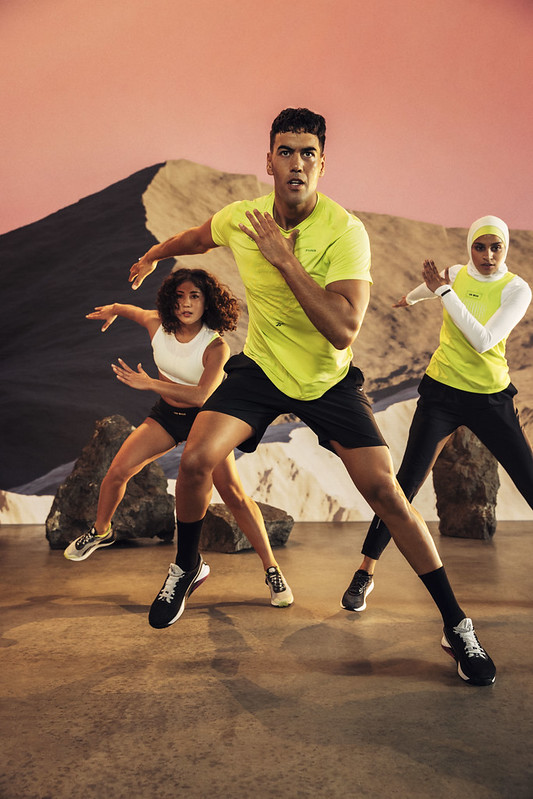
LesMills Athletic (2_1577)
Les Mills Group Fitness – Photo credit Les Mills Asia Pacific

Pada bulan Mei 2021, kami meninjau lebih daripada 12,000 konsumer kecergasan di seluruh dunia dan bertanya, “Apakah tabiat anda pos-pandemik?”.

Majoriti berkata, “Saya ingin dikelilingi rakan-rakan saya, berada di gimnasium, saya ingin menyertai grup kecergasan! Tapi aku sudah terbiasa, dan menikmati kenyamanan bekerja di luar rumah”. 60% berkata mereka ingin melatih di gimnasium dengan rakan-rakan dan instruktor. 40% berkata mereka akan latih bersendirian. Pada masa ini kami terlibat melalui aplikasi, atau TV. Langkah seterusnya adalah realiti maya, realiti tambahan antara tempat ketiga antara kerja dan rumah. Fikirkan jenama Apple, Amazon dan Google. Misi Apple mengelilingi kesihatan individu dan mereka ingin menjadikan dunia lebih sihat. Masa kita di ruang tradisional itu singkat, tetapi terdapat banyak peluang juga.

12:27 (AFT-Jasmine) Dengan ini meta alam semesta besar datang ke depan, apa yang Les Mills benar-benar semua tentang?

(LMAP-Ryan) “For a Fitter Planet”! Itulah risalah Les Mills. Kami ingin mengubah pengalaman kecergasan dalam dinamik grup. Kami bersemangat tentang kualiti kelas kami, kami bersemangat tentang kualiti instruktur kami dan kami benar-benar percaya pada sukses menjalankan aktiviti grup.

LesMills Virtual Fitness
Les Mills Virtual Training – – Photo credit Les Mills Asia Pacific

Memandangkan latar belakang saya walaupun pra-Les Mills, bersenam dalam kumpulan adalah apa yang mengubah hidup saya. Di dunia Les Mills, kita memiliki istilah ini kita sebut groupness. Maksud saya ia bukan perkataan yang sebenar, tetapi kuasa kumpulan adalah keterangkuman berada dalam kumpulan, ia adalah akauntabiliti berada dalam kumpulan, muncul ke kelas dengan rakan-rakan anda, sambungan yang anda ada dengan pengajar di atas pentas yang sangat bersedia untuk menyampaikan pengalaman seolah rockstar, ia adalah peningkatan tenaga yang anda dapat dari berada di sekeliling orang lain.

Seperti kita semua, saya telah melalui beberapa lockdown semasa covid-19 ini. Saya mempunyai persediaan rumah yang cukup baik jadi saya dilatih melaluinya kerana senaman adalah sebahagian daripada hidup saya tetapi lockdown tidak akan menghentikan itu. Saya melakukan senaman yang sama di rumah tetapi saya mendapati bahawa monitor kadar jantung saya menunjukkan saya bekerja 30% lebih keras apabila bekerja dalam kumpulan dengan rakan-rakan di studio daripada ketika berada di rumah. Dan itulah kekuatan dari sebuah kelompok! Ini adalah angkat kolektif berada di sekitar orang-orang yang bekerja dengan Anda dengan instruktur. Kuasa pasang surut.

Satu lagi analogi yang boleh saya buat adalah perbezaan antara mendengar muzik di Spotify dan apabila mendengar lagu yang sama yang dipersembahkan secara langsung dalam konsert, yang dipersembahkan di hadapan penonton secara langsung, ia adalah kuasa pasang surut yang semakin meningkat, itulah kekuatan kumpulan.

15:00 (AFT-Jasmine): Nombor lapan, Move8 adalah idea di mana anda memerlukan lapan orang dalam grup untuk menggalakkan satu sama lain untuk beraktif. Keluarga saya mempunyai Penyakit Ginjal (Type 2 Diabetes). Bermulanya, saya pra-diabetik tetapi sejak memulakan podcast ini, saya telah berjaya membalikkan pra-diabetes saya. Jadi kami ingin berkongsi melalui podkes ini.

Apa yang Les Mills cuba lakukan di seluruh Asia Tenggara, termasuk di Guam, Maldives.. Jadi jika saya seorang instruktur kecergasan dan saya berminat untuk menyertai Les Mills, bagaimana saya melakukannya?

(LMAP-Ryan) Kami telah melatih lebih dari 140,000 instruktur aktif di seluruh dunia, dan ratusan ribu instruktur tiday aktif selama 25 tahun, kami sudah cukup baik pada sistem yang telah kami ciptakan. Jika anda berada di Asia Tenggara atau Australia, itu adalah proses tiga hari yang rusak selama beberapa bulan. Anda akan mendapat latihan kemahiran program BODYPUMP® atau apa sahaja yang anda mahu belajar, kemudian dua hari di mana anda diajar asas-asas apa yang diperlukan dalam menyampaikan pengalaman bertaraf dunia. Selepas dua hari itu, anda keluar dan bekerja dengan mentor pengajar di kelab kesihatan tempatan anda, dan anda mula membayangi di mana anda berada di atas pentas berdiri di belakang pengajar, meniru pergerakan tanpa pengajaran, maka akhirnya anda memulakan pengajaran pasukan, di mana anda berkongsi kelas, di mana mentor anda akan memberi anda maklum balas. Lapan minggu kemudian, anda muncul pada hari ketiga, di mana anda kemudian membentangkan (mengajar) beberapa lagu kepada rakan-rakan anda beberapa kali dan selepas hari ketiga jika anda telah memenuhi kriteria dan lulus penilaian, anda mula mengajar. Ini tidak mudah! Kami dikenal untuk pelatihan tidak mudah sama sekali. Ini adalah latihan yang menuntut secara fizikal, kerana anda perlu menjadi model peranan fizikal jika anda akan menjadi pengajar dengan jenama. Kami mempunyai kriteria yang sangat ketat dan ia juga mungkin gagal. Tetapi kami bangga dengan kriteria yang anda perlukan untuk memenuhi dan di luar latihan, ada peningkatan kemahiran yang berterusan. Program kami dikemas kini setiap suku tahun dan pengajar kami perlu meningkatkan kemahiran setiap suku tahun dengan mempelajari siaran baru.

Ini adalah bagaimana kita mengekalkan obsesi kita dengan kualiti. Kami telah melakukan 120-130 siaran setiap tiga bulan dan kami tidak berhenti walaupun semasa Covid. Kita perlu mengemas kini setiap suku tahun dan kita perlu memastikan bahawa kita mempunyai pergerakan terkini dan muzik terkini, dan kita tidak berhenti walaupun semasa Covid. Kami memastikan kami menemukan cara untuk membuatnya bekerja bahkan selama penguncian ketat. Kandungan kami secara global dihasilkan di Auckland, New Zealand di mana studio rakaman kami terletak. Obsesi ini dengan kualiti benar-benar sebahagian daripada siapa kita.

19:50 (AFT-Jasmine) Bagaimanakah pemilik gimnasium mendaftar masuk ke perkongsian Les Mills?

Apabila anda bekerjasama dengan Les Mills, kami akan datang dan melesenkan produk dan kelas, dan kami menambah nilai dengan menyokong anda dengan menguruskan jadual waktu kecergasan kumpulan anda. Selalunya kelab kesihatan adalah perniagaan kecil-sederhana dan mempunyai beberapa cabaran yang berbeza dan kecergasan kumpulan adalah salah satu daripada mereka. Kami benar-benar bekerjasama dengan kelab dan membawa nilai positif. Kelab hartanah dan kesihatan kecergasan kumpulan harus menjadi bahagian hartanah yang paling menguntungkan dalam kelab kesihatan kerana bilangan orang yang anda boleh berpaling ganda.

21:00 (AFT-Nikki): Beritahu kami lebih lanjut tentang misi Les Mills, “For a Fitter Planet”.

(LMAP-Ryan) Ada buku ini oleh Simon Sinek, “Mulakan dengan Mengapa”, perniagaan hebat bermula dengan mengapa dan apa yang lebih hebat mengapa daripada Untuk Planet Fitter. Ini benar-benar tentang segala sesuatu yang kita lakukan. Kami percaya pada kekuatan kecergasan untuk benar-benar mengubah planet ini, untuk mengubah cara kita hidup dan kesihatan kita. Kecergasan adalah salah satu elemen kesihatan, ia adalah apa yang anda makan, tidur anda, ia adalah tentang mewujudkan Planet Fitter. Kami percaya melalui kualiti kelas kecergasan kumpulan kami, sama ada di kelab atau di rumah melalui aplikasi Les Mills PLUS, kami benar-benar boleh menyumbang kepada planet yang lebih sihat dan cergas. Ini obsesi yang kita miliki tentang terus bergerak maju.

22:20 (AFT-Jasmine) Di Singapura dan Malaysia, kami sudah biasa dengan jenama seperti Class Pass, K-Fit, Guava Pass dan lain-lain. Apa pendapat anda tentang peluang seperti ini untuk pengguna, dan di sisi lain, untuk perniagaan?

(LMAP-Ryan) Mereka adalah “aggregator”, dan bagi konsumer, ianya bagus sebab ramai. Ia memberi pengguna lebih banyak peluang untuk mencuba senaman yang berbeza. Ia hebat di sisi lain untuk kemudahan, studio dan kelab kerana ia adalah hebat untuk mengakses lebih ramai orang dan mendapatkan lebih ramai orang melalui pintu mereka. Ia bagus untuk studio yang lebih kecil yang berjuang untuk mendapatkan lebih ramai orang ke gim mereka. Akhirnya ia adalah tentang mendemokrasikan akses kepada kecergasan. Sekiranya jenama ini mendapat lebih banyak orang yang lebih aktif, itu adalah perkara yang baik.

27:50 (AFT-Jasmine): Adakah anda fikir model perniagaan gim akan berubah pada masa akan datang?

(LMAP-Ryan) Penyelidikan baru-baru ini yang kami lakukan pada bulan Mei 2021 menunjukkan sambutan yang luar biasa kepada, “Saya mahu bersenam dengan orang lain, saya mahu berada dalam kumpulan, saya mahu berada di sekeliling orang lain”. Itu adalah alasan no. 1 mengapa aku ingin keluar. Saya tidak percaya gim akan berubah secara drastik, selain daripada mereka perlu memeluk digital. Ia secara tradisinya sejenis perniagaan batu bata dan mortar, anda mendapat keahlian, kami mahu anda datang ke gim sekerap yang anda boleh kerana itu meningkatkan kepenatan dan anda akan tinggal lebih lama, tetapi kami tahu bahawa selepas dua tahun belajar bagaimana untuk bersenam di rumah, sebahagian daripada kita telah menjadi agak baik pada itu, jadi gimnasium, kelab kesihatan perlu belajar tentang bagaimana untuk menjadi saluran pengedaran untuk itu, dan bersaing dengan orang-orang seperti Apple, Google dan lain-lain. Apple tidak ingin membawamu ke gym. Apple mahu membuat anda sihat dan menjual jam tangan dan telefon anda.

Kelab kesihatan atau gimnasium benar-benar boleh menjadi pusat itu. Ia boleh menjadi tempat ketiga. Anda telah mendapat rumah, kerja dan tempat ketiga, di mana di banyak negara tempat ketiga akan menjadi pub. Gim bisa menjadi tempat ketiga. Jika pengguna memakan kecergasan secara digital, maka gimnasium perlu melihat bagaimana mereka boleh menjadi sebahagian daripada itu dan bagaimana mereka boleh memberikan pengalaman yang luar biasa di gimnasium dan juga di rumah, maka ahli mereka tidak perlu pergi ke tempat lain.

Saya tidak fikir model perniagaan akan berubah sebanyak itu tetapi bagaimana anda menunaikan janji yang akan berubah.

Dalam penyelidikan, negara mana yang paling aktif ketika datang ke kecergasan?

(LMAP-Ryan) Australia, New Zealand, Amerika Syarikat, United Kingdom dan Eropah Barat, dan ia tidak ada kaitan dengan budaya tetapi kematangan industri kecergasan. Jika anda melihat peratusan penduduk di negara-negara Asia yang merupakan ahli gimnasium, ia sangat rendah. Walau bagaimanapun, jika anda melihat penyertaan bandar di bandar-bandar besar seperti Kuala Lumpur, Bangkok atau Jakarta, ia jauh lebih tinggi. Potensi untuk berkembang adalah untuk berpindah dari pusat bandar ke negara ini.

27:50 (AFT-Jasmine) Apakah ada konvensi tahunan yang les Mills jalankan?

(LMAP-Ryan) Pra-Covid, ya, kita telah melakukannya. Kami mempunyai komuniti besar, besar, besar pengajar dan jurulatih di Eropah dan komuniti besar di Amerika Utara – pasaran kecergasan terbesar di dunia. Kami digunakan untuk berkumpul di suatu tempat di Eropa di mana kita bisa membuat banyak kebisingan! Yang terakhir kami lakukan adalah di sebuah resor di Eropa Selatan. Ia hebat!

Kami juga telah pergi digital dengan persidangan dan acara dalam talian tetapi kami benar-benar melihat untuk menghasilkan Les Mills Live, di mana kami membawa jenama hidup-hidup kepada masyarakat. Ia berjalan beberapa hari, dengan program yang dicipta oleh pengajar di New Zealand. Les Mills Live terakhir adalah di Marina Bay Sands di Singapura dengan lebih dari 2000 instruktur. Kami menjalankan pertempuran badan dengan lebih daripada 1200 orang di kelas di dalam bilik BIG dengan banyak skrin dan pentas BIG. Ini mengenai kelompokan, dan bagaimana bersenam dengan hanya beberapa rakan sekerja di dalam bilik, kini bayangkan dengan 1200 orang. Ini pengalaman yang hebat! Perhimpunan besar itu adalah sebahagian daripada keteguhan jenama kami, dan kami benar-benar berharap untuk melakukannya lagi.

32:00 (AFT-Jasmine): Mengapa anda fikir orang Australia dan New Zealand hanya begitu baik pada program kecergasan?

(LMAP-Ryan) Antipodeans, iaitu Australia dan New Zealand mempunyai budaya sukan BIG yang tertanam dari ketika anda masih kecil, anda membuang bola atau menendang bola, anda berlari atau berenang, anda berada di kolam renang atau menyelam. Sukan di TV, anda pergi ke footie dengan bapa anda, pasangan anda, lelaki atau perempuan, ia adalah sebahagian daripada budaya yang berurat berakar dan konsep menjadi sihat dan sihat tertanam dalam budaya. Yang saya pikir berbeda dari seluruh dunia.

Try this 30-minute at-home Strength Training Workout | BODYPUMP | LES MILLS x REEBOK: https://youtu.be/kPl66RocFDo

Terima kasih kerana menyertai kami pada satu lagi episod Move it, Move 8, Move AID Podcast. Langgan pada platform podcast pilihan anda.


Show Credits:

  • Thanks to Analee at Les Mills Asia Pacific for making this interview happen.
  • AFT Podcasts is co-hosted, produced and edited by Jasmine Low & Nikki Yeo. This transcript has been edited for brevity.
  • Recorded live on December 2021 at Sydney Podcast Studios in St. Leonards, Australia.

Subscribe to AsiaFitnessToday’s newsletter and never miss free access to premium content, early access to live streamed interviews and more!
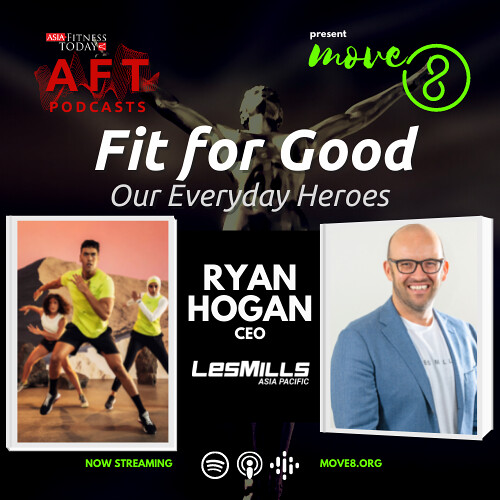
Move8 Podcast ft. Ryan Hogan, CEO Les Mills APAC
Liked this? Share it with someone.

Republish this:

AsiaFitnessToday.com Interviews: Ryan Hogan, CEO Les Mills Asia Pacific is on a mission to make the planet fitter and healthier is licensed under a Creative Commons Attribution-ShareAlike 4.0 International license. Source: https://www.asiafitnesstoday.com/aft-interviews-ryan-hogan-les-mills-asia-pacific/

Share this:
Share

Facebook Comments

By Jasmine Low

Jasmine Low is intrigued by sound frequencies, loves long walks, hikes and is co-creator of the Move8 fitness movement. She is writing her first book #listenbyheart, a concept presented at a TedX event and wears the hat of co-founder of Experiential Media & Technology group, GoInternationalGroup.com and this media network, AsiaFitnessToday.

Creative Commons License
Except where otherwise noted, © GoInternationalGroup.com on this site is licensed under a Creative Commons Attribution-NonCommercial-ShareAlike 4.0 International License.